


Home  BusinessCryptocurrencyNon-Fungible Token (NFT): What It Is, How It Works, and How to Buy or Create One
BusinessCryptocurrencyNon-Fungible Token (NFT): What It Is, How It Works, and How to Buy or Create One BusinessCryptocurrencyNon-Fungible Token (NFT): What It Is, How It Works, and How to Buy or Create One Non-fungible tokens (NFTs) are digital assets that have been tokenized using blockchain technology. Each NFT is assigned a unique ID and metadata that distinguish it from any other token.
NFTs can be bought, sold, or traded for money, cryptocurrency, or even other NFTs–it all depends on how the market and collectors value them. For example, someone could create an NFT of a banana image. One person might pay millions for it, while someone else might say it’s worthless.

Cryptocurrencies are also tokens, but the main difference is that two crypto coins on the same blockchain are interchangeable–they’re fungible. Two NFTs on the same blockchain might look identical, but they’re not interchangeable.
NFTs were created long before they gained mainstream popularity. Reportedly, the first-ever NFT was “Quantum,” developed and tokenized by Kevin McCoy in 2014 on Namecoin, then minted and sold in 2021 on Ethereum.
NFTs are built on the ERC-721 standard (Ethereum Request for Comment #721), which defines how ownership is transferred, how transactions are verified, and how apps handle secure transfers. ERC-1155, approved six months later, improves on ERC-721 by combining multiple NFTs into a single contract, which helps cut transaction costs.
In March 2021, a collection of digital artworks by Beeple sold for over $69 million. The piece was a collage of his first 5,000 days of work and set a record as the most expensive digital art sale at the time.
$69 million.
NFTs are created through a process called “minting,” where the NFT’s information is recorded on the blockchain. In simple terms, minting involves creating a new block, validating the NFT’s data, and closing the block.
Smart contracts are often part of this process. They assign ownership and manage the transfer of NFTs.
Each minted NFT is given a unique identifier tied to a specific blockchain address. Every NFT has a publicly visible owner (i.e., the address that holds it). Even if you mint 5,000 NFTs of the same item (such as movie tickets), each one has a unique ID and can be distinguished from the others.
Just like traditional NFTs, Bitcoin Ordinals can be bought, sold, and traded. The difference is that NFTs tag art or music files with serial numbers, while Bitcoin Ordinals assign IDs to individual satoshis – the most minor units on the Bitcoin blockchain.
Like physical cash, cryptocurrencies are typically fungible. That means you can trade one for another of equal value. One bitcoin is always worth another bitcoin on the same exchange, just like every US dollar bill is worth $1.
NFTs flip that concept. They’re designed to be one-of-a-kind, making it impossible to say one NFT is “equal” to another. They represent unique digital assets and are often compared to digital passports–each NFT includes non-transferable, unique ID data that makes it stand out.
NFTs can also be composable: you can combine one NFT with another to create a third, unique token.
The best-known use of NFTs is CryptoKitties. Launched in November 2017, these are digital cat images with unique blockchain IDs. Every kitty is different and has its price. They can “breed” to create offspring with new traits and valuations.

Within just weeks of its launch, CryptoKitties built a considerable fan base. Users spent over $20 million worth of Ether buying, feeding, and breeding these virtual pets. Some collectors spent more than $100,000.
More recently, the Bored Ape Yacht Club made headlines with sky-high prices, celebrity attention, and high-profile NFT thefts.
Early NFT markets focused on digital art and collectibles. Today, the scene has expanded. On marketplaces like OpenSea, NFTs now span across categories like:
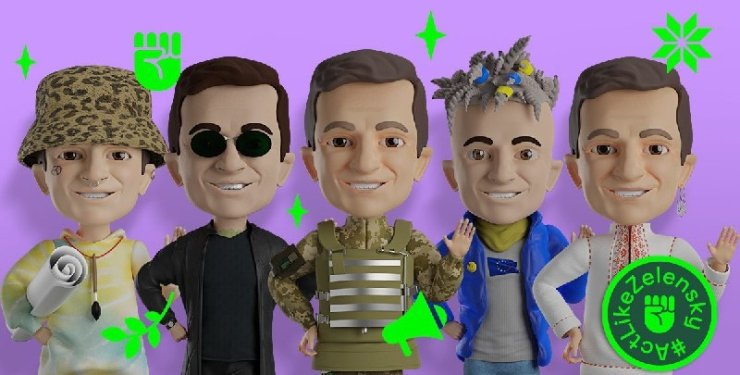
In a powerful collaboration between Ukrainian tech innovators and blockchain creators, a one-of-a-kind NFT collection featuring President Volodymyr Zelenskyy was born. This project blends art, tech, and charity with a real-life heroic narrative.
You may also like:
The #ActLikeZelensky collection features 100 unique NFTs showcasing Zelenskyy in various roles – from a military leader to a national icon to a Matrix-inspired figure. Each token is an artistic tribute to his defining traits.
All proceeds from these digital artworks will be used to purchase essential military equipment to support Ukrainian soldiers. The goal: raise €3 million to fund 1,000 thermal imagers, 500 vests, helmets, radios, and tactical flashlights.
All donations are managed by the Shields initiative, led by charity organizer Tetiana Kameneva from “Kurazh Bazar.” Any surplus funds will support other charities, such as LifelineForKharkiv and Come Back Alive, helping to keep Ukraine safe and strong.
One of the most significant benefits of NFTs is market efficiency. Tokenizing a physical asset can streamline the buying and selling process by eliminating the need for a middleman. For example, an artist can mint their artwork and sell it directly to fans–no need for galleries or agents.
NFTs can also be powerful investment tools. For example, Ernst & Young developed an NFT solution for a winery client, storing wine in a secure location and utilizing NFTs to verify its origin and authenticity.
Real estate can also be tokenized. A property can be split into sections, with each represented by a unique NFT. Say one plot is near a lake and another closer to the woods–they’d have different characteristics, prices, and NFTs.
NFTs can even represent business ownership, similar to stock shares. Shares already rely on registries that track info like shareholder name, issue date, and certificate number. Blockchain does this even better–smart contracts can automate the transfer of ownership. Sell your NFT stake, and the blockchain handles everything else.
NFTs are also helpful for identity protection. When personal data is stored on the blockchain, it can’t be accessed, stolen, or used without your private keys.
NFTs can also democratize investing by allowing people to fractionalize expensive physical assets, such as art or property. Instead of needing to buy a whole painting, investors can own a share via NFT. More buyers = more demand = potentially higher value.
Most NFTs are purchased with Ethereum (ETH), so having a crypto wallet with some ETH is typically the first step. You can buy NFTs from major platforms like OpenSea, Rarible, or SuperRare.
NFTs are generally secure because they utilize blockchain technology, which is similar to that used in cryptocurrencies. But the weak point is your private keys. If your wallet gets hacked or your device is lost, your NFT is at risk. So remember the golden rule: Not your keys, not your token. Keep your private keys safe and your NFTs will be, too.
Fungibility means that one item can be swapped for another of equal value. Imagine you have three notes with identical smiley faces. Once you tokenize one, it becomes different–it’s non-fungible. The other two can still be swapped, but that NFT stands alone.
NFTs take the basic idea of cryptocurrency and elevate it. Financial systems today handle a wide range of assets–from real estate to art–and NFTs provide a new way to represent them digitally.
Sure, representing physical items in digital form isn’t new. Neither is using unique identifiers. But when combined with secure blockchain tech, smart contracts, and automation, NFTs become a game-changer.
A non-fungible token (NFT) is a unique digital asset stored on a blockchain. It’s like a digital certificate of ownership for something one-of-a-kind–whether that’s a piece of art, a music file, a video, or even a tweet. Unlike cryptocurrencies like Bitcoin or Ethereum (which are interchangeable), each NFT is distinct and can’t be swapped on a one-to-one basis.
An NFT is simply a way to prove digital ownership using blockchain. It’s not inherently “bad,” but there are concerns. Critics often point to environmental impact (due to blockchain energy use), price speculation, scams, and the fact that owning an NFT doesn’t always mean you own the copyright to the content. Like any technology, it depends on how it’s used.
NFTs can make money in a few ways:
Like any investment, profits aren’t guaranteed, but when timed right, the gains can be significant.

 On the portal with 25.06.2023
  75 articles
  311148 переглядів

The questions you can ask a guy when communicating can be different. The main thing is that they are suitable for a c...
 April 8, 2024
  140.8 K
Standing up straight, grip the dumbbells with a neutral grip and bring your hands down in front of your hips. Bend yo...
 August 5, 2023 32.6 K
Want to find someone online by their full name? This guide shows how to use a true people search finder – from social...
June 27, 2025 20.1 K
Turkish TV series have won the hearts of millions of viewers around the world by offering exciting plots, deep emotio...
April 8, 2024 15.7 K
Explore 110 authentic compliments to make a girl feel special. Find tips and phrases to compliment a girl naturally a...
July 1, 2025 14.5 K
NFTs aren’t just a trend–they’re a new way to prove ownership online. This guide breaks down what NFTs are, how they ...
July 2, 2025 10.2 K
Looking for the perfect words to add to your photo album? We’ve gathered over 70 captions for photo albums–funny, emo...
July 3, 2025 7.2 K
Today, many amateur gardeners are interested in planting blueberries and growing tall blueberries. Its delicious berr...
February 8, 2024 6.3 K
Looking to boost your income without leaving the house? From freelance gigs to content creation, this guide reveals 1...
July 4, 2025 5.5 K
Strength training at home can be done with resistance bands. They provide a functional alternative to deadlifts, squa...
August 5, 2023 5.1 KExpert recommendations and exclusive offers in your inbox.
This section contains information about gambling and is available only to persons who are 21 years of age or older in accordance with the applicable laws of Ukraine. Please confirm that you are 21 years of age or older.
This platform does not have a Ukrainian license. The link is provided for informational purposes only. Participation in games on such sites may violate Ukrainian law.


