


Often searched for:
- Як варити яйця правильно: всмятку, в круту – дієві поради для смачного приготування
- Як вибрати якісний вологий корм для котів?
- Сумісність знаків зодіаку – детальний опис та тест на сумісність
- Вітаміни та мікроелементи для підтримання імунітету
- Де знайти вірш про маму? Красиві й щирі рядки сучасних віршів українською


Evolution is the process of gradual changes in living organisms over millions of years. It explains how simple life forms developed into more complex ones—including humans. It’s not a belief system but a scientific theory, backed by tons of evidence, research, and observation. In this article, we’ll explain in a clear and friendly way what evolution is and how modern humans—Homo sapiens—came to be.
What Is Evolution?
Evolution is the process through which biological species change from generation to generation. It’s driven by three main forces: mutations (random changes in DNA), natural selection (where the best-adapted survive), and inheritance of helpful traits. Over time, this can lead to new species appearing—or older ones disappearing.
Key point: Evolution doesn’t have a fixed goal. It happens gradually and is shaped by the environment.
How Does Evolution Work?
To understand evolution, it helps to look at three key ideas: adaptation, natural selection, and mutations.
Adaptation is how organisms adjust to their environment. This can include changes in body structure, behavior, or survival strategies—like finding food or escaping danger. These traits help a species survive.
Natural selection is the main driver of evolution. It means that individuals who are better adapted to their environment are more likely to survive and reproduce. Their traits are passed on, and over time, those traits become common in the population.
Mutations are random changes in DNA. They can happen when cells divide or due to external influences like radiation or chemicals. Some mutations are helpful—and these are the ones natural selection keeps. So while mutations are random, selection is not.
German biologist Ernst Mayr summarized natural selection as five facts and three conclusions:
Facts:
- Populations don’t grow endlessly because resources are limited.
- Individuals in a population differ from one another.
- Many of those differences are inherited.
Conclusions:
- Not all individuals survive due to competition.
- The best-adapted individuals are more likely to survive and reproduce.
- Over time, these changes can lead to the rise of new species.
How Humanity Evolved – The Stages of Evolution
Evolution is a slow, ongoing process that’s been shaping life for millions of years. In humans, natural selection favored those best suited to their environments. Our evolutionary journey is one of the most fascinating and well-studied branches of the tree of life.

Sahelanthropus tchadensis (~7 million years ago)
This early hominin had a skull with features of both apes and humans. Its structure suggests it could walk upright, even though it still lived partly in trees. The brain size was small—about 350 cm³, smaller than a chimp’s—but this species shows the first signs of upright walking, a key human trait.
- One of the oldest known hominins
- Discovered in Chad, Africa
- Ape-like but likely walked on two legs
- Brain size ~350 cm³ (smaller than a chimp)
Australopithecus afarensis (~3.9–2.9 million years ago)
The most famous example is Lucy, a skeleton found in Ethiopia. These hominins walked confidently on two legs but still had long arms for climbing. Their brain was slightly larger than a chimp’s—about 400–500 cm³. They didn’t make tools, but likely used sticks and stones from nature.
- Walked upright on two legs
- Brain size: 400–500 cm³
- A mix of human and ape traits: short legs, long arms, but free hands for tools
Homo habilis (~2.4–1.4 million years ago)
The first officially recognized human species. The name means “handy man”—and rightly so. These early humans started making basic stone tools. Their brains reached up to 800 cm³, double that of earlier species. Signs of early culture, social life, and a broader diet (plants and meat) begin to appear.
- First Homo species – “handy man”
- Used simple stone tools
- Brain size: 500–800 cm³
- Ate both plants and meat
Homo erectus (~1.9 million – 110,000 years ago)
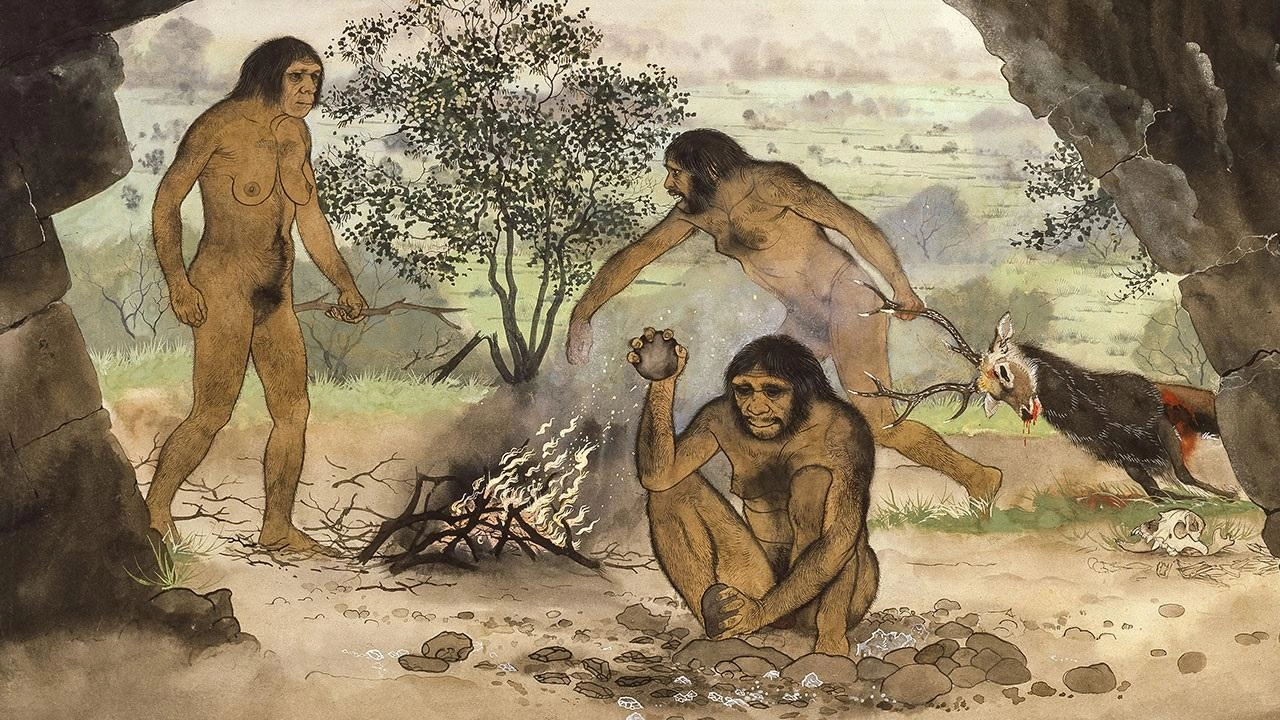
One of the most successful human species. Homo erectus didn’t just make tools—he left Africa and spread into Asia and Europe. With an upright posture, tall build, and strong body, this species had a brain size between 600–1100 cm³. They used fire for cooking and warmth, built shelters, and likely began developing language.
- Very successful species
- Fully upright with strong build
- Used fire, migrated across Eurasia
- Built shelters, hunted, and showed early signs of speech
You may also like:
Homo heidelbergensis (~600–200 thousand years ago)
This species was a link between Homo erectus and later humans like Homo sapiens and Neanderthals. With a strong body and a larger brain (~1200 cm³), they made advanced tools and hunted in groups. Evidence suggests they buried their dead—early signs of culture and beliefs.
- Likely ancestor of both Homo sapiens and Neanderthals
- Used advanced tools, hunted in groups
- May have practiced early burial rituals
Homo neanderthalensis (~400–40 thousand years ago)
Our closest evolutionary relatives, Neanderthals lived mainly in Europe and Western Asia. Their stocky build helped them survive the Ice Age. With brains sometimes larger than ours (~1400 cm³), they made complex tools, wore jewelry, buried their dead, and probably had language. They even interbred with Homo sapiens—some of their genes still live on in us.
- Lived in Europe and Western Asia
- Brain size: up to ~1400 cm³
- Adapted to cold, made tools, wore ornaments
- Had language, buried the dead, interbred with modern humans
Homo sapiens (~300,000 years ago – present)
Modern humans first appeared in Africa and spread across the globe. We have large brains (1300–1500 cm³), high foreheads, and the ability to think abstractly. We created language, art, religion, science, and technology. We live in societies, formed civilizations, invented agriculture—and even reached space. Evolution continues, now shaped not just by biology, but also by culture and technology.
- Modern humans
- Originated in Africa
- Large brains, abstract thinking, speech, creativity
- Developed agriculture, science, and global societies
What Is Evolution – Video
Watch this short and engaging video that explains evolution in a fun and simple way.
Learning about evolution isn’t just fascinating—it helps you see yourself as part of Earth’s bigger story. It shows how everything is connected, how nature works, and how our world keeps changing.
Frequently Asked Questions
Is evolution over?
No, evolution is still happening. As long as life exists, evolution continues. Humans and all other species keep changing due to mutations, natural selection, genetic drift, and more. These changes might just be too slow or subtle for us to notice right away.
Why don’t modern apes become human?
Humans didn’t evolve from modern apes. We share a common ancestor with them. Our evolutionary paths split around 6–7 million years ago. Since then, we’ve evolved separately. Apes are well adapted to their own environments—they didn’t face the same evolutionary pressures our ancestors did.
Do all living things come from a common ancestor?
Yes. There’s a strong scientific agreement that all life on Earth comes from a single origin—a creature known as LUCA (Last Universal Common Ancestor), which lived over 3.5 billion years ago. We know this thanks to shared DNA, cell structures, and biochemistry across all life forms.
Can evolution create a brand-new species?
Yes. When populations of a species are isolated (by geography, for example), they develop differences over time. If they become so different they can’t breed with each other anymore, they become separate species. This is called speciation.
Does “survival of the fittest” mean the strongest survive?
Not exactly. It means “the best adapted survive.” That might be strength or intelligence—but it could also be speed, camouflage, teamwork, or even being less noticeable. It’s all about what works best in a specific environment.

 On the portal with 10.12.2023
  2 articles
  928 переглядів
 Table of contents 
You may be interested:

The questions you can ask a guy when communicating can be different. The main thing is that they are suitable for a c...
 April 8, 2024
  140.8 K
Standing up straight, grip the dumbbells with a neutral grip and bring your hands down in front of your hips. Bend yo...
 August 5, 2023 32.6 K
Want to find someone online by their full name? This guide shows how to use a true people search finder – from social...
June 27, 2025 20.1 K
Turkish TV series have won the hearts of millions of viewers around the world by offering exciting plots, deep emotio...
April 8, 2024 15.7 K
Explore 110 authentic compliments to make a girl feel special. Find tips and phrases to compliment a girl naturally a...
July 1, 2025 14.5 K
NFTs aren’t just a trend–they’re a new way to prove ownership online. This guide breaks down what NFTs are, how they ...
July 2, 2025 10.2 K
Looking for the perfect words to add to your photo album? We’ve gathered over 70 captions for photo albums–funny, emo...
July 3, 2025 7.2 K
Today, many amateur gardeners are interested in planting blueberries and growing tall blueberries. Its delicious berr...
February 8, 2024 6.3 K
Looking to boost your income without leaving the house? From freelance gigs to content creation, this guide reveals 1...
July 4, 2025 5.5 K
Strength training at home can be done with resistance bands. They provide a functional alternative to deadlifts, squa...
August 5, 2023 5.1 K⚠️ This platform does not have a Ukrainian license. The link is provided for informational purposes only. Participation in games on such sites may violate Ukrainian law.
Expert recommendations and exclusive offers in your inbox.
Expert recommendations and exclusive offers in your inbox.
Access only for persons over 21 years of age
This section contains information about gambling and is available only to persons who are 21 years of age or older in accordance with the applicable laws of Ukraine. Please confirm that you are 21 years of age or older.
This platform does not have a Ukrainian license. The link is provided for informational purposes only. Participation in games on such sites may violate Ukrainian law.